

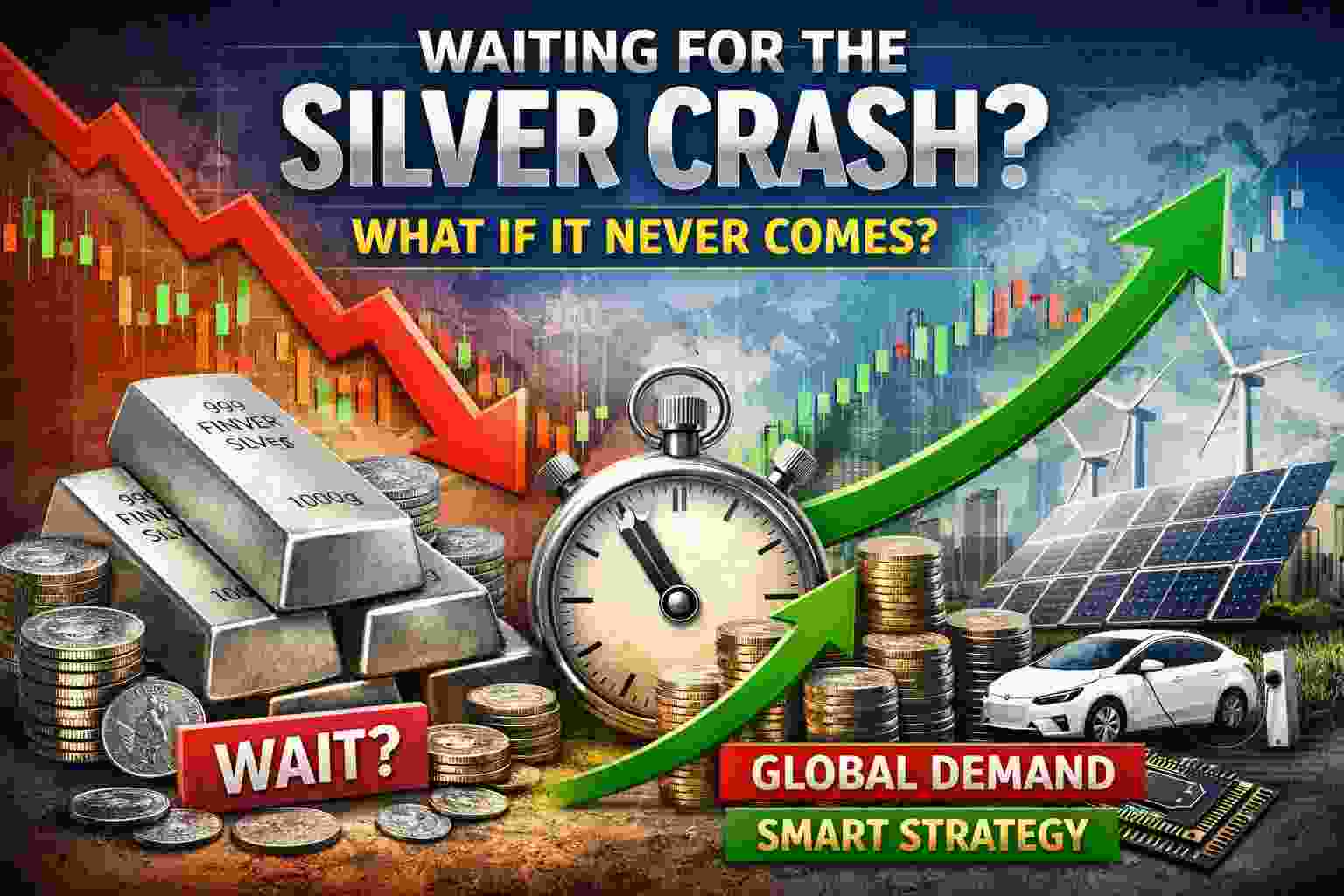
For many investors, silver today feels like a train that has already left the station. Prices have risen sharply in a short time, silver ETFs are trading at premiums, and every small dip is quickly bought. Yet, a large section of investors is still waiting on the sidelines, hoping for a “big crash” before entering.
The question is simple:
What if that crash never truly comes?
To answer this, we must look beyond local opinions and examine what the world’s biggest economies and market participants are saying — especially in the United States, China, and Russia, where both financial and industrial demand for silver is shaping the global trend.
Silver’s Sharp Rally and Global Attention
Silver has surged at a pace rarely seen before, driven by a mix of investor interest, industrial demand, and supply stress. In the United States, some analysts have warned that silver may face short-term corrections after such a rapid rise. However, even those who expect a pullback do not describe it as a long-term collapse.
Across global markets, silver is now behaving like a structurally supported but volatile asset — one that may fall in phases, but is quickly supported by fresh buying.
China: Falling Inventories and Strategic Control
Chinese market reports show that silver inventories have dropped to multi-year lows. At the same time, prices in Shanghai have been trading at a premium compared to global markets, signalling physical shortage.
China has also tightened export controls on silver, treating it as a strategic resource. This reflects rising domestic demand from solar energy, electric vehicles, electronics, and advanced manufacturing.
From China’s perspective, silver is not just a trading asset — it is a production input that cannot be easily replaced. Any major price dip is therefore likely to attract strong industrial buying.
Russia: Corrections Are Part of the Cycle
Russian financial newspapers describe the current silver market as moving from “record highs to healthy corrections.” Analysts there acknowledge volatility but also note that each decline is being met with renewed buying interest.
Russia’s view aligns with global trends: supply constraints, limited mining growth, and rising industrial usage are creating a long-term support base beneath prices.
Will High Prices Reduce Industrial Demand?
A common concern is that rising silver prices may increase production costs for industries, forcing them to reduce usage. However, silver plays a critical role in:
- Solar panels
- Electronics and semiconductors
- Electric vehicles
- Medical devices
There are few effective substitutes. Instead of abandoning silver, industries usually adjust pricing, improve efficiency, or pass on a small portion of the cost to consumers.
This creates a cycle where any sharp fall in price invites immediate buying, preventing a prolonged crash.
What Should Investors Do Instead of Waiting?
Trying to time a perfect crash is risky. If prices continue rising, investors may miss the opportunity altogether. At the same time, entering with a lump sum may expose one to short-term volatility.
A balanced solution is a staggered or SIP-style approach:
- Divide your investment into 10–15 parts
- Invest gradually over time
- Keep some capital aside
- Use any correction as an opportunity to invest more
This way, you remain invested while still being prepared for market dips.
Final Thought
From the United States to China and Russia, one message is clear:
Silver is evolving from a precious metal into a strategic industrial resource.
Yes, corrections will happen.
But a long and deep crash appears unlikely when global buyers are waiting at lower levels.
The real risk may not be silver falling —
the real risk may be waiting too long and missing the move.
Disclaimer
This article is for informational and educational purposes only and does not constitute financial or investment advice. Please consult a qualified financial advisor before making any investment decisions.
Leave a Reply