

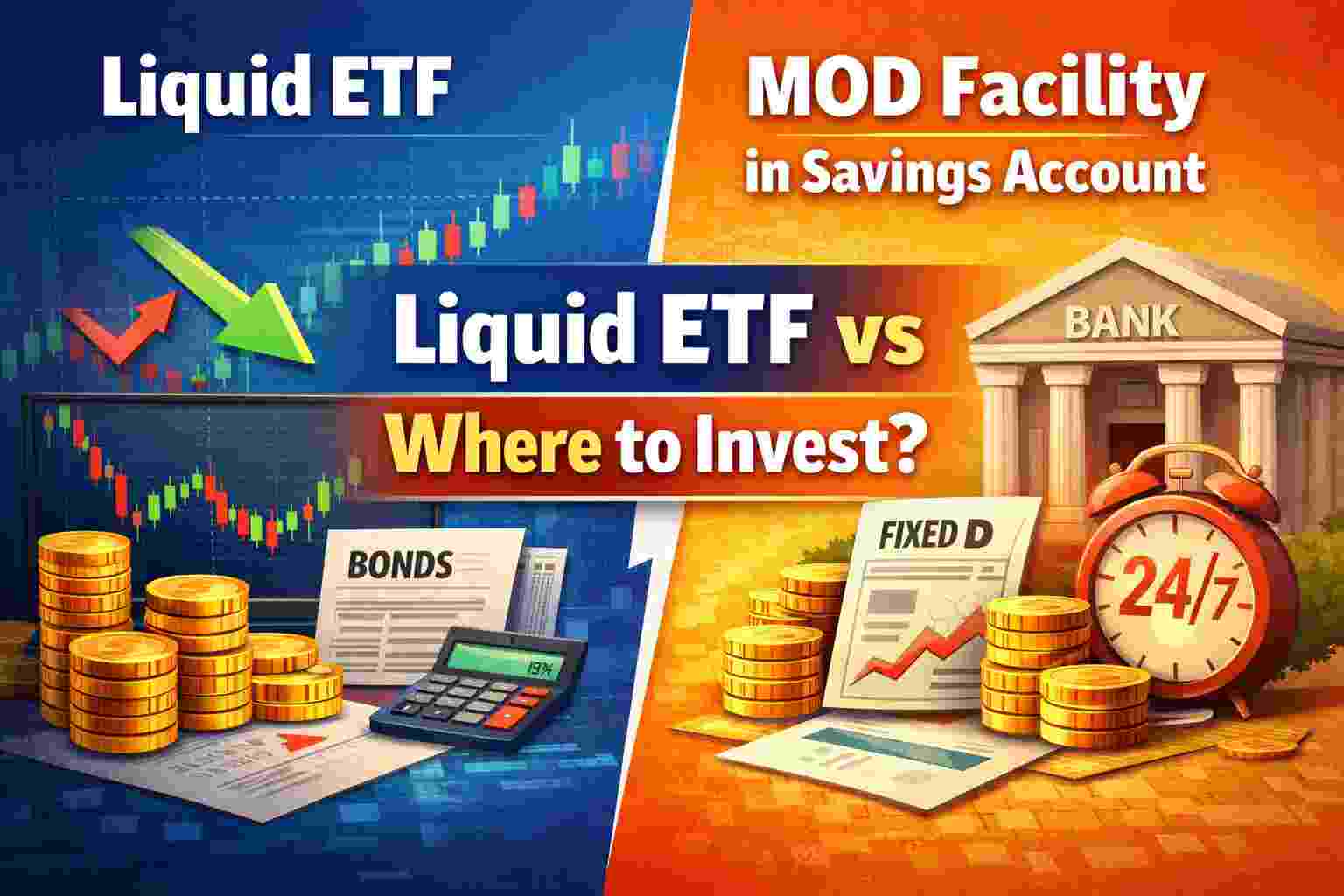
When it comes to parking surplus money for the short term, most people instinctively keep funds in a savings account. However, experienced investors often explore smarter alternatives that offer better returns without compromising liquidity. Two popular options in India are Liquid ETFs and the MOD (Multi Option Deposit) facility linked to savings accounts. Let us understand how they work, their benefits, risks, and which option may suit different investors.
What is a Liquid ETF?
A Liquid ETF is an exchange-traded fund that invests in high-quality, short-term money market instruments such as treasury bills, commercial papers, and certificates of deposit. These instruments typically mature within 91 days, making Liquid ETFs suitable for short-term parking of funds.
Liquid ETFs aim to provide stable returns slightly higher than savings accounts, while maintaining high liquidity. They are traded on stock exchanges, so buying and selling happens during market hours.
MOD Facility in Savings Account
Most banks now offer a MOD facility where excess money in a savings account is automatically converted into fixed deposits. When funds are needed, the FD is broken partially or fully, and money flows back into the savings account seamlessly. While savings accounts offer only 2–3% interest, MOD-linked FDs usually provide 5–6% interest, making them far more attractive.
This is why financially aware individuals rarely keep large balances idle in savings accounts and instead rely on MOD facilities.
Liquid ETF vs MOD Facility: Key Differences
Liquid ETFs generally offer returns comparable to or slightly higher than MOD FDs, depending on market conditions. However, Liquid ETFs do not guarantee returns. Though rare, their NAV can move slightly down due to interest rate changes or credit events. Over very short periods, small losses are possible, though historically they tend to be stable.
On the other hand, the MOD facility offers guaranteed returns, instant liquidity, and zero market risk. Funds are available 24×7, even on bank holidays, which is a major advantage over Liquid ETFs that depend on market trading hours.
Risks: Can Liquid ETFs Make Losses?
Yes, Liquid ETFs can technically see small declines in value. They are not risk-free like bank FDs. However, the risk is generally low if the ETF invests in high-quality instruments. Still, they do not “definitely go up”, unlike fixed deposits.
Should You Invest?
Liquid ETFs may suit investors who are comfortable with minimal market-linked fluctuations and want better tax efficiency or diversification. MOD facilities are ideal for those who value certainty, instant liquidity, and peace of mind.
Final Thought
For conservative investors, the MOD facility remains a dependable choice. Liquid ETFs are better viewed as a slightly flexible, market-linked alternative, not a replacement for guaranteed bank deposits.
Leave a Reply