

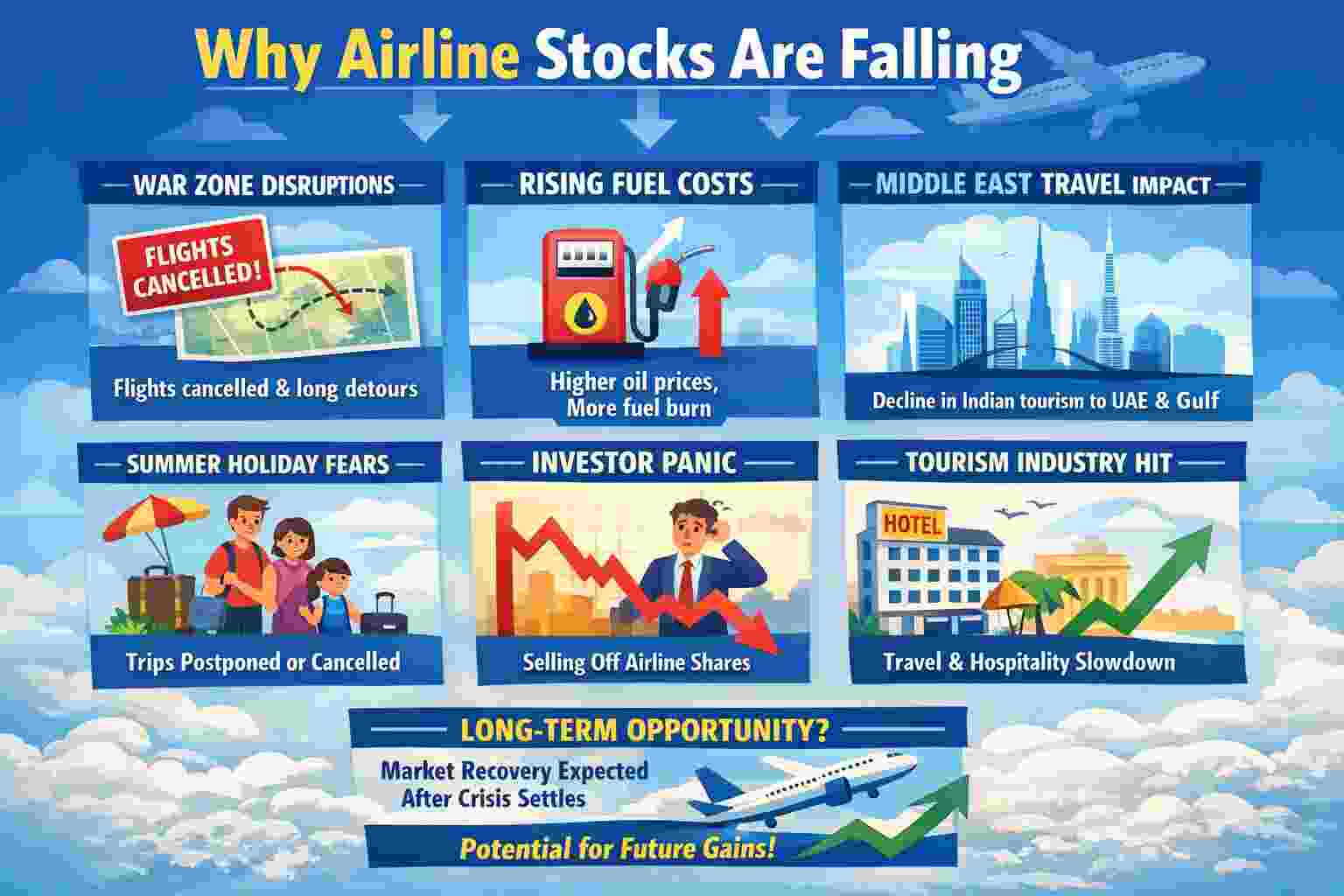
Airline stocks around the world are facing turbulence. Over the last few sessions, share prices of several aviation companies have declined sharply, and Indian airline stocks are no exception.
Whenever uncertainty rises at a global level, aviation is one of the first sectors to feel the pressure. Let us understand calmly and clearly why this is happening.
1. War and Airspace Disruptions
Aviation depends on stable global connectivity. When war breaks out or tensions rise between countries, the first immediate impact is on airspace access.
Flights that were scheduled to land in countries involved in conflict are being cancelled. At the same time, aircraft that normally pass through certain regions are now forced to take longer alternative routes for safety reasons.
This creates two immediate problems:
- Direct revenue loss from cancelled flights
- Increased operational cost due to longer flying distance
Airlines operate on thin margins. Even small disruptions can significantly affect profitability.
2. Rising Fuel Prices – The Biggest Pressure Point
Fuel is the lifeline of aviation. It forms a major portion of an airline’s operating cost.
When geopolitical tensions rise, crude oil prices usually move up because of supply concerns. Higher crude oil directly means higher aviation turbine fuel (ATF) prices.
Now imagine the double impact:
- Fuel becomes expensive.
- Flights are taking longer routes and burning more fuel.
This squeezes profit margins from both sides. Investors quickly price this risk into airline stocks, leading to selling pressure.
3. Impact on Indian Airlines
Indian carriers like InterGlobe Aviation (IndiGo), SpiceJet, and Air India have strong connectivity with the Middle East.
Routes to cities such as Dubai, Abu Dhabi, and Doha are extremely important for Indian airlines. These routes serve:
- Tourists
- Business travellers
- NRI traffic
- Connecting passengers to Europe and beyond
If even a part of this traffic gets disrupted, revenues take a hit.
4. Summer Travel Season at Risk
The timing is also important. In India, the summer vacation season is approaching. Traditionally, a large number of Indian tourists travel abroad during this period.
The Middle East, especially the United Arab Emirates, is one of the most preferred international destinations. Dubai alone attracts millions of visitors every year, and Indians form one of the largest tourist groups.
But when news of war spreads, people naturally become cautious. Even if a destination is not directly affected, nearby regional tensions can make travelers postpone or cancel plans.
This softens demand at a time when airlines expect peak bookings.
5. Investor Psychology and Market Reaction
Stock markets do not wait for actual damage to show in quarterly results. They react to future expectations.
When investors see:
- Higher fuel cost risk
- Demand uncertainty
- Route disruptions
- Possible decline in international travel
They start reducing exposure to aviation stocks.
Additionally, global funds often sell emerging market stocks (including Indian airline shares) during geopolitical stress and shift towards safer assets. This adds further downward pressure.
6. Tourism and Travel Ecosystem Also Affected
Airlines are not alone in this situation. Travel booking platforms, tour operators, and hospitality companies may also face slower growth if international travel demand cools down.
The aviation sector works in a chain. When one link weakens, others feel the pressure too.
Is This a Long-Term Problem?
History tells us something important.
Geopolitical conflicts are rarely permanent. Eventually, diplomacy, negotiation, or exhaustion leads to de-escalation. When stability returns, travel demand usually rebounds strongly.
People who postponed their vacations tend to re-book. Business travel resumes. Airlines adjust fares. Oil prices stabilize.
If the core fundamentals of an airline remain strong — healthy balance sheet, efficient operations, strong route network — then temporary stock price declines can sometimes become long-term opportunities.
Leave a Reply