

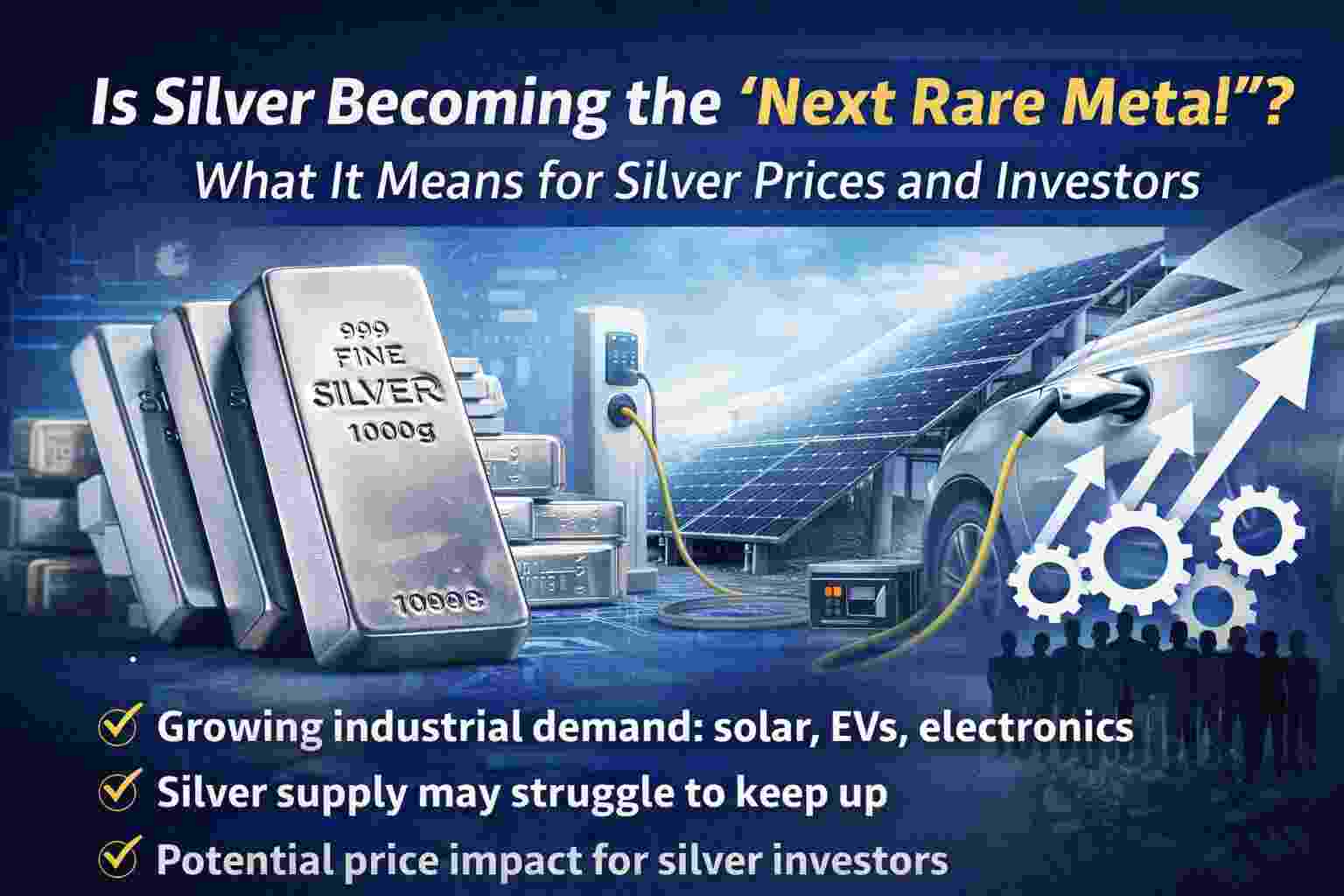
What It Means for Silver Prices and Investors
Silver is no longer just about jewellery or a hedge against inflation. With rising use in solar panels, electric vehicles, electronics, and clean energy, many investors are beginning to ask an important question:
Is silver slowly turning into a rare or scarce material—and what does that mean for its price?
Let’s understand this step by step, in simple words.
What Exactly Is Rare Earth Material?
The scientific meaning (important to know)
Rare earth materials are a fixed group of 17 chemical elements, such as neodymium, lanthanum, scandium, and yttrium. These elements are essential for modern technologies like EV motors, wind turbines, semiconductors, and defence equipment.
They are called “rare” not because they don’t exist, but because:
- They are hard to extract
- They are rarely found in pure form
- Processing them is expensive and complex
👉 This definition is scientific and permanent.
Can Any Material Become a Rare Earth?
Short answer: No (scientifically)
A material is called “rare earth” only if it belongs to that chemical group.
Price rise, demand surge, or scarcity cannot change this classification.
So from a chemistry point of view:
- Silver is NOT a rare earth material
- Silver will never be one
But for investors, the story doesn’t end here.
Then Why Is Silver Being Talked About Like a “Rare” Material?
The economic and investment perspective
In markets, a material is often informally called “rare” when it starts showing these traits:
Key scarcity parameters investors care about:
- Limited or slow-growing supply
- Rapid increase in industrial demand
- Difficulty in substitution
- Strategic importance for future technologies
- Depleting above-ground inventories
Now let’s see how silver fits into this picture.
Does Silver Show These Scarcity Signs?
Yes, increasingly so.
1. Supply is constrained
Most silver is not mined directly. It comes as a by-product of copper, lead, and zinc mining. This means silver supply does not easily increase even if prices rise.
2. Industrial demand is rising fast
Silver is heavily used in:
- Solar panels
- Electric vehicles
- Charging infrastructure
- Electronics and semiconductors
- Medical applications
These sectors are structural growth areas, not temporary trends.
3. Very hard to replace
Silver has the highest electrical conductivity of all metals. For many high-performance applications, there is no real alternative.
4. Recycling is limited
Much of the silver used in electronics is not economically recyclable. Once used, it’s often gone from the supply chain.
👉 This combination makes silver look less like a traditional metal and more like a strategically scarce resource.
So, Is Silver Becoming a Rare Earth?
Scientifically: ❌ No
Economically and strategically: ⚠️ It’s starting to behave like one
Silver may not be a rare earth, but it is increasingly behaving like a critical metal, where:
- Demand grows faster than supply
- Shortages can appear
- Prices re-rate over time, not just spike briefly
What Could This Mean for Silver Prices?
If these trends continue:
- Silver prices may see long-term structural support
- Industrial users may compete with investors for supply
- Price cycles could become stronger and sharper
- Silver may move beyond being just a “safe-haven metal” and become a technology-linked asset
This doesn’t mean prices will rise in a straight line—but it does mean the long-term outlook strengthens.
What Does This Mean for Silver Investors?
Physical silver investors
- Benefit most during real supply tightness
- No counterparty risk
- Premiums can rise during shortages
Silver ETF and paper investors
- Easy liquidity and convenience
- Prices track spot silver
- May not fully capture physical scarcity premiums in extreme cases
Silver is no longer just a speculative trade. It is slowly becoming a strategic asset, supported by both industrial demand and investor interest.
Thought for Silver Investors
Silver does not need to be called a “rare earth” to become valuable.
Its growing role in clean energy, electrification, and advanced technology is enough to make it one of the most important metals of the coming decade.
For long-term investors, this shift suggests that silver may deserve a more meaningful and thoughtful place in portfolios—not just as a hedge, but as a growth-linked commodity.
Leave a Reply