

The Union Cabinet has officially cleared the formation and Terms of Reference for the 8th Central Pay Commission (8th CPC), marking a major step toward revising pay, allowances, and pensions for Central Government employees and pensioners.
Who Will Lead the 8th CPC?
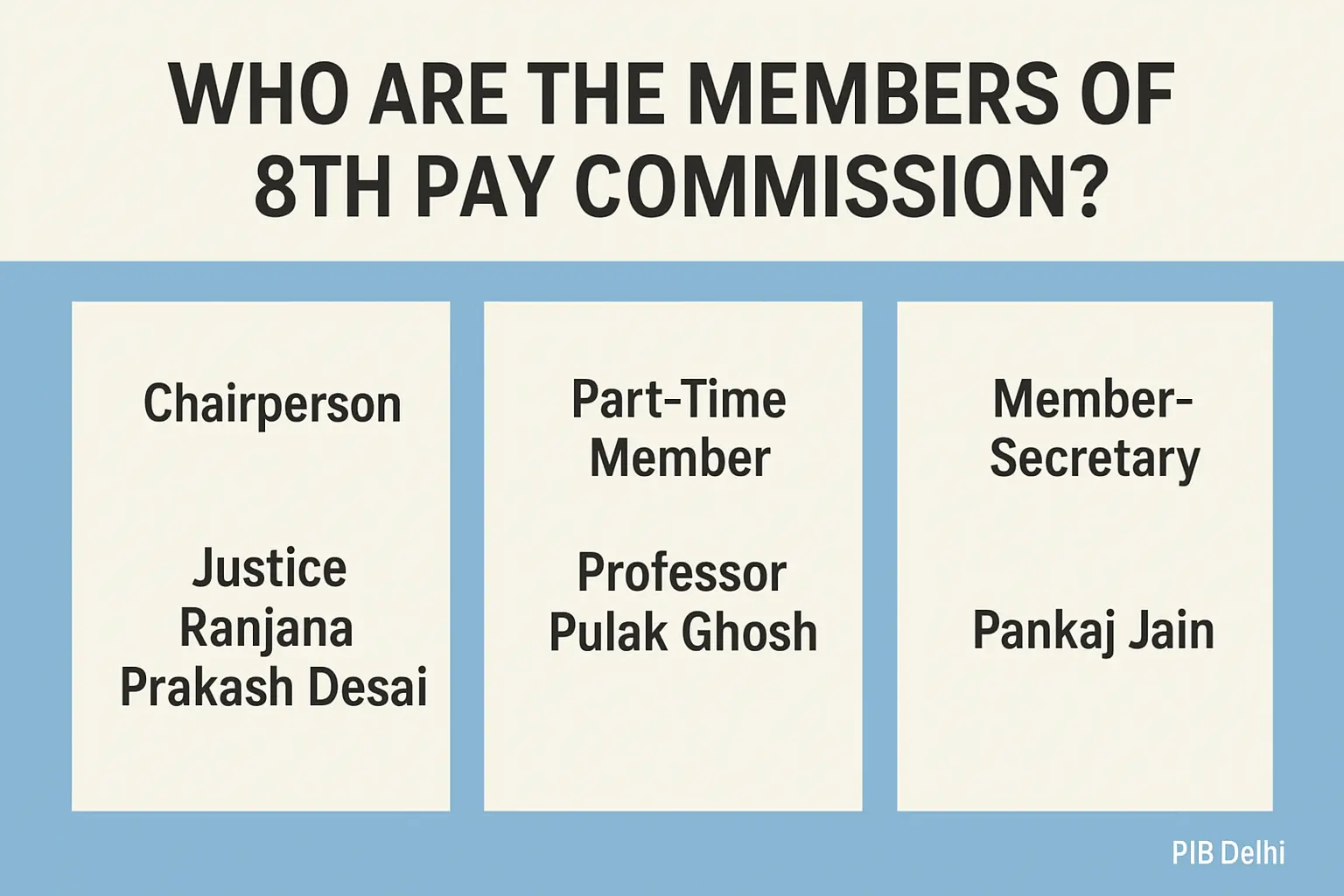
The government has appointed a three-member panel with a blend of judicial, academic, and administrative expertise:
Composition Table
| Role | Name | Current/Former Designation |
|---|---|---|
| Chairperson | Justice Ranjana Prakash Desai | Former Judge, Supreme Court of India |
| Part-Time Member | Professor Pulak Ghosh | Professor, IIM Bangalore |
| Member-Secretary | Pankaj Jain | Secretary, Petroleum & Natural Gas Ministry |
Justice Ranjana Prakash Desai – Chairperson
Justice Desai is a former judge of the Supreme Court of India known for her strong legal expertise and balanced judgments. After retiring from the Supreme Court, she has headed several important commissions, including the Delimitation Commission of India. Her experience in judicial review, governance matters, and policy-related work brings credibility and depth to the 8th CPC’s leadership.
Professor Pulak Ghosh – Part-Time Member
Professor Pulak Ghosh is a senior faculty member at IIM Bangalore and one of India’s leading experts in data science, analytics, and public policy. He has worked closely with government agencies on labor markets, pensions, and financial inclusion. His academic insights and analytical expertise will help the Commission evaluate pay structures from an evidence-based perspective.
Pankaj Jain – Member-Secretary
Pankaj Jain is a senior IAS officer currently serving as Secretary in the Ministry of Petroleum and Natural Gas. Over his career, he has held key positions in economic affairs, finance, and public administration. Known for his strong administrative and policy formulation skills, he will manage the Commission’s operations and coordinate the development of its final recommendations.
What the Commission Will Do
The 8th CPC will study and recommend revisions to salaries, allowances, and pensions for nearly 50 lakh Central Government employees and around 69 lakh pensioners. It will factor in:
- The current economic environment
- Fiscal stability and long-term sustainability
- Pay comparisons across the public and private sectors
- The financial impact on both the Centre and the States
Timeline
The commission has been given 18 months to submit its final report. Based on previous trends, its recommendations are expected to come into effect from January 1, 2026, unless the government announces a different rollout schedule.
Leave a Reply