

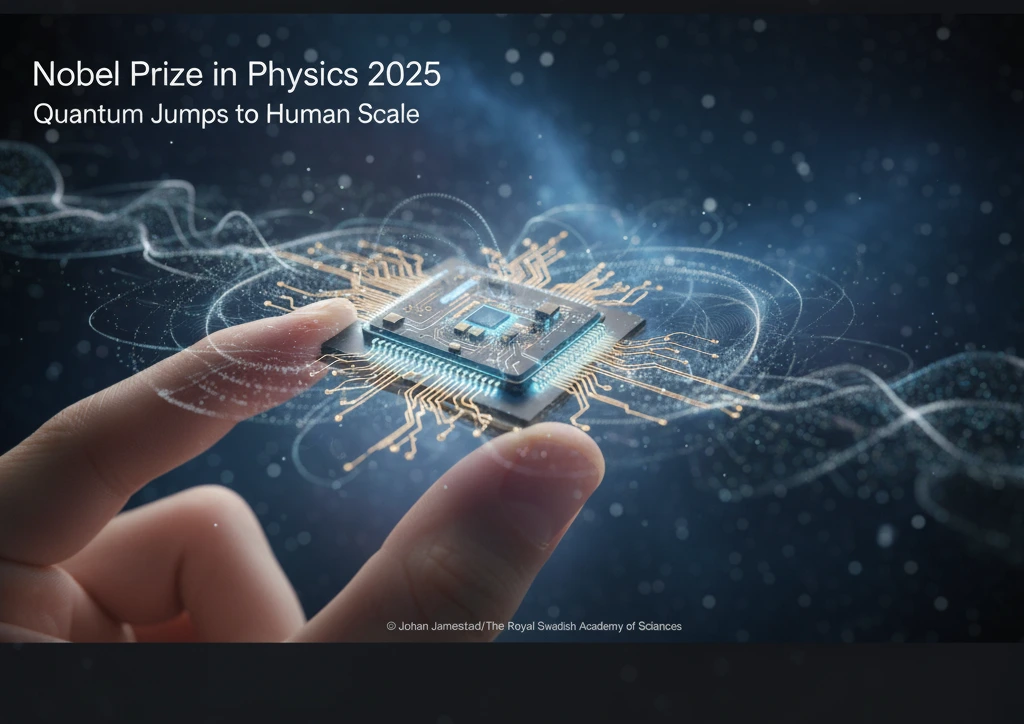
October 07, 2025— The Royal Swedish Academy of Sciences today awarded the 2025 Nobel Prize in Physics to John Clarke, Michel H. Devoret, and John M. Martinis for their groundbreaking work, “for the discovery of macroscopic quantum mechanical tunnelling and energy quantisation in an electric circuit.”
The three laureates successfully demonstrated that the bizarre, non-intuitive properties of the quantum world are not confined to the subatomic realm but can be observed in a system large enough to be held in the hand. Their pioneering experiments have provided a crucial foundation for the next generation of quantum technologies.
Quantum Physics Goes Macro
For decades, one of the central questions in physics has been how large a system can be while still exhibiting fundamental quantum mechanical effects. The work by Clarke, Devoret, and Martinis, conducted in a series of pivotal experiments in the mid-1980s, decisively answered this question.
Using a superconducting electrical circuit, which was integrated onto a chip only about a centimeter in size, the trio brought two cornerstone quantum phenomena out of the microscopic world:
- Macroscopic Quantum Tunnelling: The researchers showed that their electrical system could spontaneously change from one state to another, as if it were passing straight through an energy barrier—a phenomenon known as quantum tunnelling. This effect, which defies classical physics, was observed in a system involving billions of charged particles (Cooper pairs) acting as a single, coherent quantum object.
- Quantised Energy Levels: The team also demonstrated that their circuit absorbed and emitted energy in discrete, specific doses, or “quanta,” confirming the quantum mechanical prediction of quantised energy levels in a tangible, engineered device.
“It is wonderful to be able to celebrate the way that century-old quantum mechanics continually offers new surprises,” said Olle Eriksson, Chair of the Nobel Committee for Physics, highlighting the fundamental importance of the discovery.
Fueling the Quantum Technology Revolution
The Royal Swedish Academy of Sciences noted that this year’s prize opens vast opportunities for developing the next generation of quantum technology.
The laureates’ work on superconducting circuits, particularly those incorporating a device called a Josephson junction, has become a foundational element for:
- Quantum Computers: Their discoveries laid the groundwork for the development of superconducting quantum bits (qubits), which are central to the race to build powerful quantum computers.
- Quantum Cryptography: Enabling ultra-secure communication systems.
- Quantum Sensors: Paving the way for ultra-sensitive measurement tools.
John Clarke (University of California, Berkeley), Michel H. Devoret (Yale University and University of California, Santa Barbara), and John M. Martinis (University of California, Santa Barbara) will share the prize amount of 11 million Swedish Kronor (approximately $1.2 million).
The announcement follows the awarding of the Nobel Prize in Physiology or Medicine on Monday and precedes the upcoming prizes in Chemistry, Literature, Peace, and Economics later this week. The laureates will receive their awards at a formal ceremony in Stockholm on December 10.
Leave a Reply